Sunscreen for Indian Skin: How to Choose and Apply It
Table of contents
If you buy only one skincare product, make it sunscreen. Choosing the right sunscreen for Indian skin protects you from tanning, dark spots, early wrinkles and sunburn — and it makes every other product in your routine work better. Yet many people skip it because it feels greasy, leaves a white cast or seems unnecessary on cloudy days.
Here is a simple guide to understanding SPF and PA ratings, picking a formula you will actually enjoy wearing, and applying the right amount.
Why sunscreen for Indian skin matters
Melanin gives Indian skin some natural protection against burning, but it does not stop UV damage. Ultraviolet rays — UVA and UVB — still cause:
- Tanning and uneven tone, especially on the cheeks, forehead and hands;
- Dark spots and pigmentation, including marks left by acne;
- Early ageing — fine lines, loss of firmness and dull skin;
- Sunburn on long days outdoors, at the beach or in the hills.
UVA rays pass through clouds and window glass, so daily use matters even if you work indoors.
SPF, PA and broad spectrum explained
| Label | What it means | What to choose |
|---|---|---|
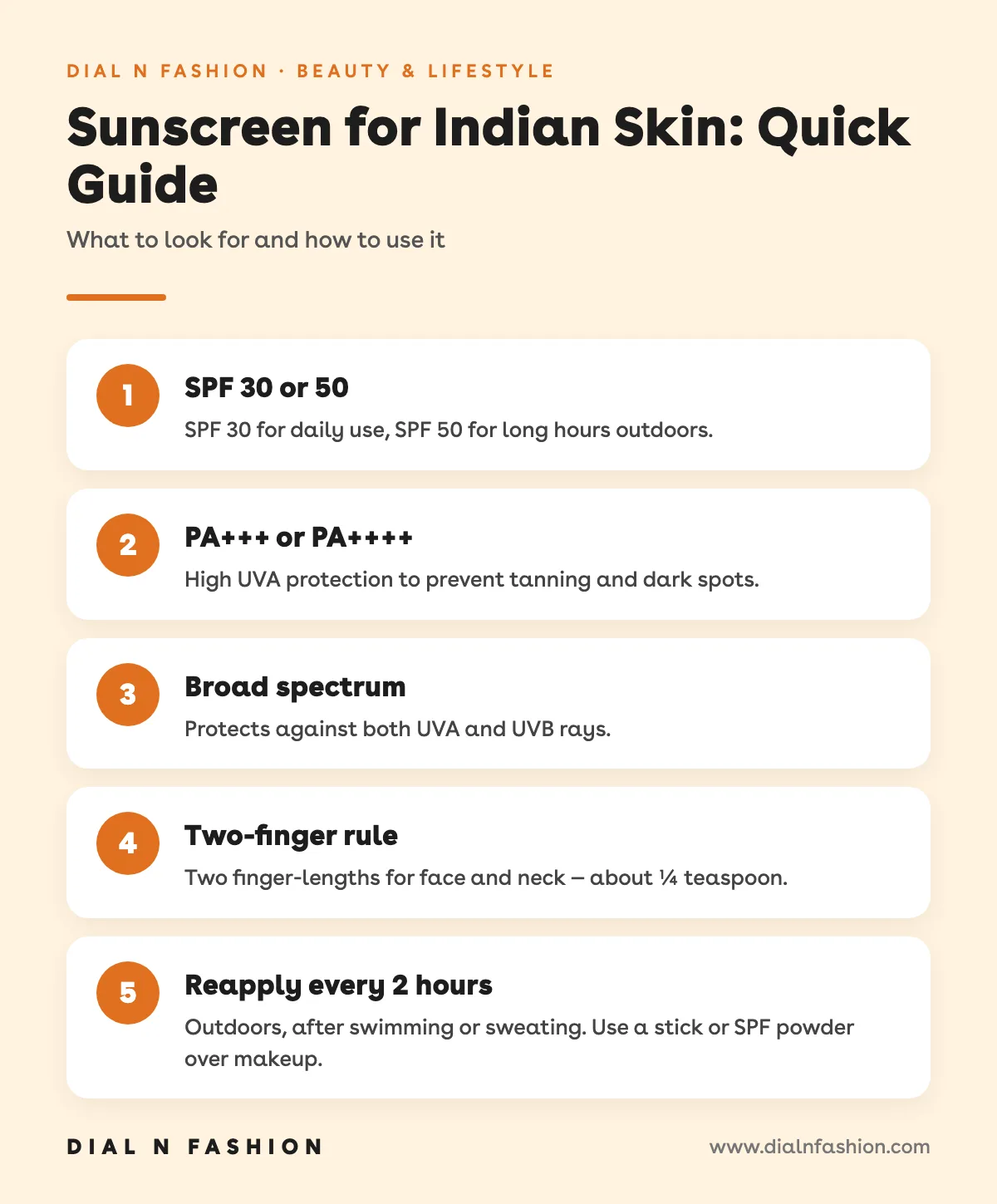
| SPF | Protection against UVB rays, which cause sunburn | SPF 30 for daily use, SPF 50 for long hours outdoors |
| PA+ to PA++++ | Protection against UVA rays, which cause tanning and ageing | PA+++ or PA++++ |
| Broad spectrum | Protects against both UVA and UVB | Always look for it |
| Water resistant | Stays effective for 40 or 80 minutes in water or sweat | For swimming, sport and humid days |
Mineral or chemical sunscreen?
Mineral (physical) sunscreens use zinc oxide or titanium dioxide. They are gentle on sensitive skin but can leave a white or grey cast on medium and deep skin tones — choose tinted versions to avoid this.
Chemical sunscreens absorb UV rays. They are usually lighter, blend invisibly and suit daily wear under makeup. Hybrid formulas combine both.
The best sunscreen formula for your skin type
- Oily or acne-prone: gel or fluid sunscreen labelled oil-free or non-comedogenic, with a matte finish.
- Dry: cream or lotion sunscreen with hydrating ingredients like glycerin or hyaluronic acid.
- Combination: lightweight lotion or gel-cream.
- Sensitive: fragrance-free mineral or hybrid formula; patch-test first.
- Deeper skin tones: tinted mineral or invisible chemical formulas to avoid a white cast.
How much sunscreen to apply
Most people use only a quarter of the amount tested in the lab. For the face and neck, use about a quarter teaspoon — the easy way to measure is the two-finger rule: squeeze two full lines of sunscreen along your index and middle fingers.
- Apply sunscreen as the last step of your morning skincare, after moisturiser.
- Dot it over the forehead, cheeks, nose, chin and neck, then spread evenly.
- Do not forget the ears, back of the neck and hands.
- Wait 10–15 minutes before going out or applying makeup.
- Reapply every two hours outdoors, and after swimming, sweating or towelling.
The American Academy of Dermatology has a clear guide on how to apply sunscreen if you want more detail.
Reapplying over makeup
Reapplying in the middle of the day is easier than it sounds. Carry a sunscreen stick, an SPF spray or an SPF powder in your bag and pat it on over makeup. A blotting paper first helps on oily skin.
Common sunscreen mistakes
- Relying on makeup with SPF. You never apply enough foundation to get the SPF on the label.
- Skipping it at home. UVA comes through windows.
- Using last year’s bottle. Check the expiry date; heat in Indian summers can break formulas down faster.
- Forgetting the rest of the body. Arms, hands and feet tan too.
Sun protection beyond sunscreen
Pair sunscreen with a wide-brim hat, UV-protective sunglasses, a light cotton dupatta or scarf, and shade between 11 am and 3 pm. Packing for a beach or hill trip? Our travel packing tips help you carry everything without overpacking, and our guide to sunglasses for your face shape helps you pick the right pair.
Final thoughts
The right sunscreen for Indian skin is broad spectrum, SPF 30 or more with PA+++ or higher, suits your skin type and feels good enough to wear every day. Apply two fingers’ worth each morning, reapply when you are outdoors, and make it the one step you never skip in your daily skincare routine.

Chirag
Writer at Dial N Fashion, covering Indian ethnic wear, street style and everyday fashion.